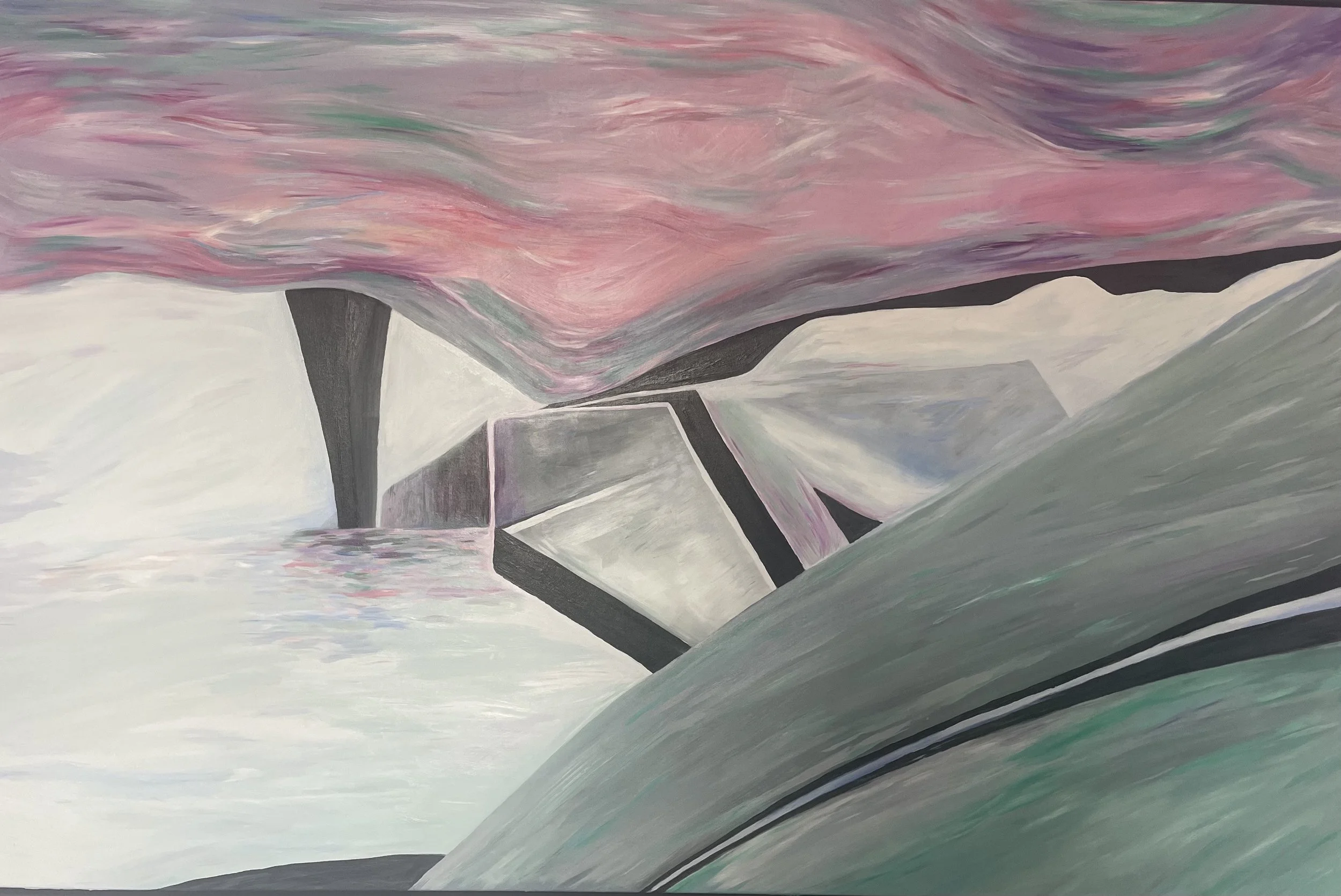
In this monumental oil on canvas, the artist takes the familiar architecture of the international art world—those slick, globalized arteries of movement and spectacle—and detonates them into a painterly fever dream. Based on a photograph of an international art gallery’s interior, complete with escalators rising and falling through space, the original image has been so thoroughly abstracted that any direct reference evaporates. What remains is the psychic residue.
The pink sky—an impossible, synthetic blush tinged with sickly purples and bruised greens—hangs like the afterglow of an artificial sunset. Below it, a surreal terrain unfolds: white cliff-like formations jut up like ruins of modernism, while a muted green-grey foreground foreshadows pools of water, rippling and glassy. The escalators—the machines of cultural ascent and descent—have been transformed into monolithic black pillars, silent and inert, casting long shadows in an otherwise airless world.
What’s remarkable here is the stillness. Though dystopian in tone, this is not a painting of collapse or chaos—it’s the eerie quiet after. A vacuum of meaning lingers in the space. The artist resists nostalgia or critique; instead, they offer an environment emptied out, scraped clean of bodies, of purpose, of signage, and left to hover somewhere between memory and dream, between architecture and geology.
There is something deeply unsettling—and deeply seductive—about this dislocation. It’s as though the bones of the institution remain, but its heart has vanished. You’re left wandering a world where the only things moving are your eyes. This isn’t just abstraction. It’s haunted abstraction.
In this monumental oil on canvas, the artist takes the familiar architecture of the international art world—those slick, globalized arteries of movement and spectacle—and detonates them into a painterly fever dream. Based on a photograph of an international art gallery’s interior, complete with escalators rising and falling through space, the original image has been so thoroughly abstracted that any direct reference evaporates. What remains is the psychic residue.
The pink sky—an impossible, synthetic blush tinged with sickly purples and bruised greens—hangs like the afterglow of an artificial sunset. Below it, a surreal terrain unfolds: white cliff-like formations jut up like ruins of modernism, while a muted green-grey foreground foreshadows pools of water, rippling and glassy. The escalators—the machines of cultural ascent and descent—have been transformed into monolithic black pillars, silent and inert, casting long shadows in an otherwise airless world.
What’s remarkable here is the stillness. Though dystopian in tone, this is not a painting of collapse or chaos—it’s the eerie quiet after. A vacuum of meaning lingers in the space. The artist resists nostalgia or critique; instead, they offer an environment emptied out, scraped clean of bodies, of purpose, of signage, and left to hover somewhere between memory and dream, between architecture and geology.
There is something deeply unsettling—and deeply seductive—about this dislocation. It’s as though the bones of the institution remain, but its heart has vanished. You’re left wandering a world where the only things moving are your eyes. This isn’t just abstraction. It’s haunted abstraction.