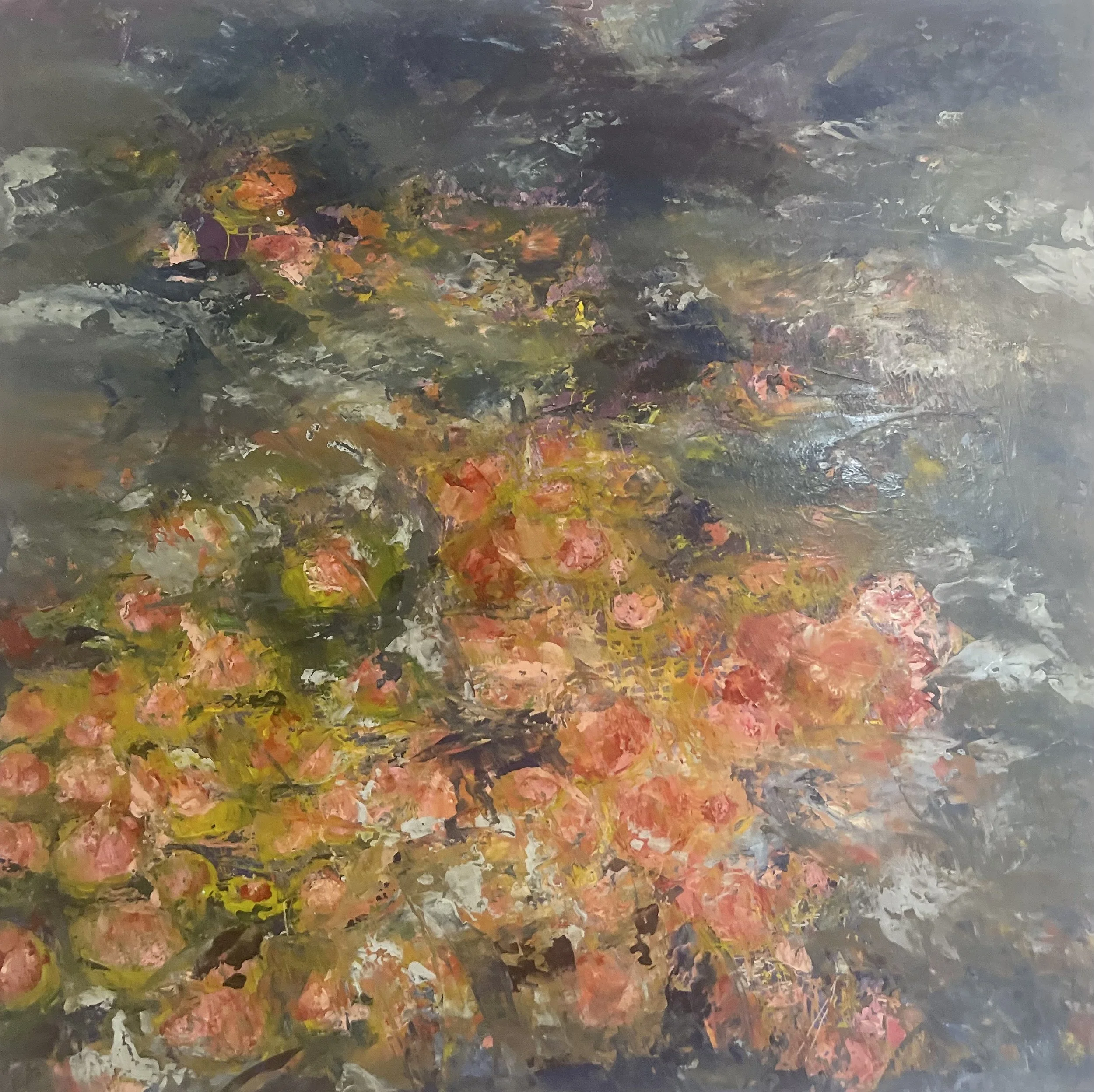
On initial encounter, the painting pays quiet homage to Monet’s lilies — the delicate floral forms floating across the surface, ephemeral and lovely. But this is no serene pond. The water, rendered in molten layers of encaustic wax, heaves and swirls in places, muddy and unsettled. Pigments bleed and blend into one another, as though the elements are still in motion, still becoming. The wax doesn’t try to imitate water; it feels like water — thick, difficult, mysterious.
Out of this chaos, lilies rise. Some push forth with clarity, pink and white forms emerging like sudden breaths in a restless tide. Others are partially lost, only half-born. The tension between the swirling undercurrent and the stillness of the blossoms is where the work lives
What this piece understands, and lets us feel, is that beauty doesn’t float above suffering — it grows from it. The artist doesn’t offer a neat dichotomy between chaos and calm; instead, both are part of the same process. It’s a painting about becoming. About how, in the thick of the mess, something luminous still rises — slowly, unevenly, but inevitably.
In that way, the work becomes a kind of spiritual ecology. Nothing is wasted, not even the mud.
On initial encounter, the painting pays quiet homage to Monet’s lilies — the delicate floral forms floating across the surface, ephemeral and lovely. But this is no serene pond. The water, rendered in molten layers of encaustic wax, heaves and swirls in places, muddy and unsettled. Pigments bleed and blend into one another, as though the elements are still in motion, still becoming. The wax doesn’t try to imitate water; it feels like water — thick, difficult, mysterious.
Out of this chaos, lilies rise. Some push forth with clarity, pink and white forms emerging like sudden breaths in a restless tide. Others are partially lost, only half-born. The tension between the swirling undercurrent and the stillness of the blossoms is where the work lives
What this piece understands, and lets us feel, is that beauty doesn’t float above suffering — it grows from it. The artist doesn’t offer a neat dichotomy between chaos and calm; instead, both are part of the same process. It’s a painting about becoming. About how, in the thick of the mess, something luminous still rises — slowly, unevenly, but inevitably.
In that way, the work becomes a kind of spiritual ecology. Nothing is wasted, not even the mud.