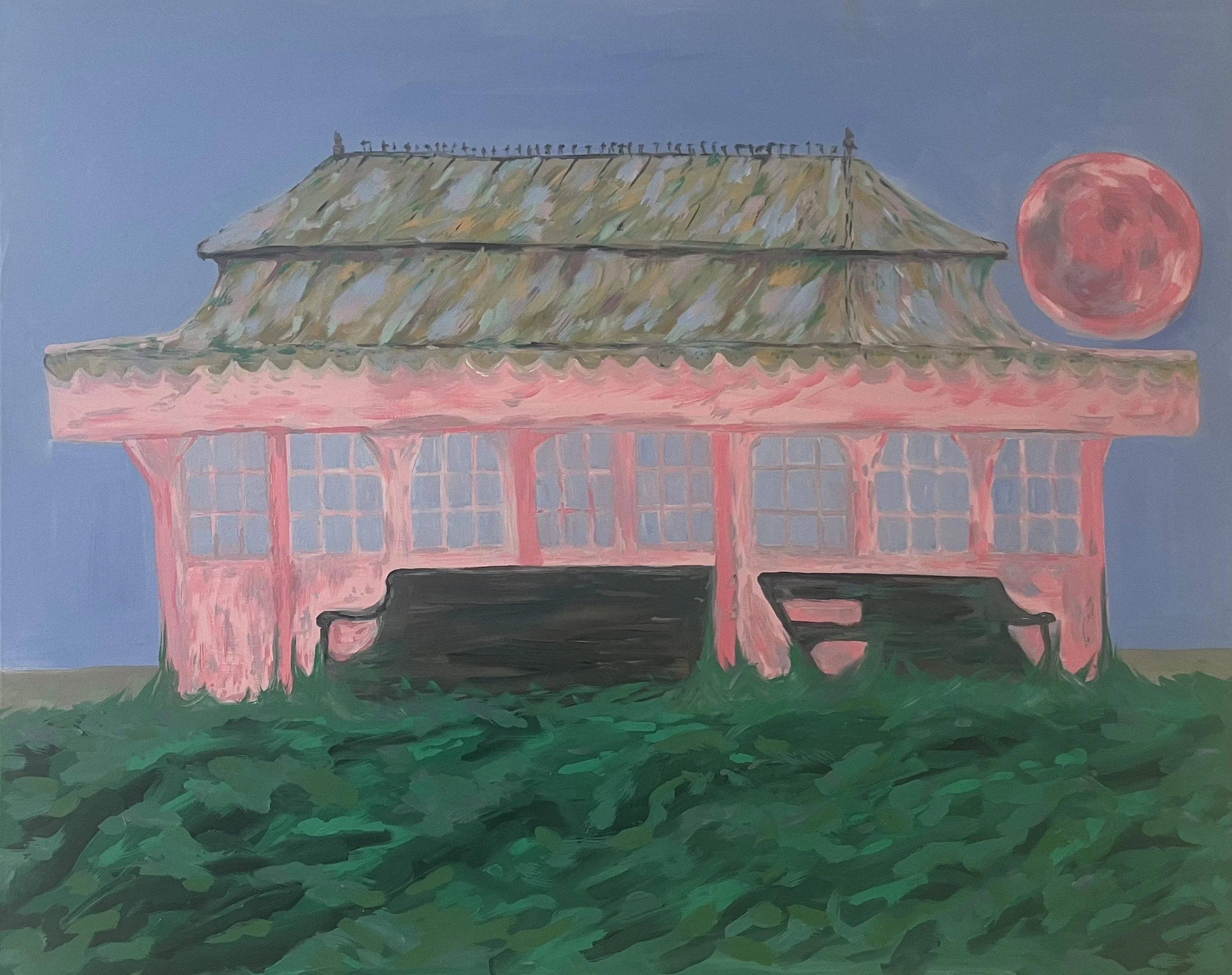
At first glance, this painting of a bus shelter at sunset might seem like a quiet suburban scene: grass, sky, a pink structure glowing oddly in the fading light. But look again, and it begins to unravel — not in meaninglessness, but in mystery. The brushwork is loose, almost evasive, especially in the green grass, which seems more like memory than landscape. The black seats sit empty, facing no one, not even each other. The pink of the shelter echoes the pink moon overhead, but it’s not a romantic pink — it’s more spectral, the colour of something once warm that has since cooled.
What’s striking is how still it feels, even with all this colour. There’s no figure, but the absence is deeply present — as if the person who once waited here has simply let go of the need to arrive anywhere. In that sense, the painting isn’t really about a place at all. It’s about a turning point — the quiet, almost unnoticed moment when the self begins to dissolve in pursuit of something more enduring. Not a dramatic spiritual awakening, but the slow surrender of ego to something quieter, deeper, and far less certain.
This is contemporary painting at its most honest — modest in its imagery, but expansive in its intent. It doesn’t shout to be seen. It waits, like the shelter itself, for the viewer to sit for a while and notice what’s really missing.
At first glance, this painting of a bus shelter at sunset might seem like a quiet suburban scene: grass, sky, a pink structure glowing oddly in the fading light. But look again, and it begins to unravel — not in meaninglessness, but in mystery. The brushwork is loose, almost evasive, especially in the green grass, which seems more like memory than landscape. The black seats sit empty, facing no one, not even each other. The pink of the shelter echoes the pink moon overhead, but it’s not a romantic pink — it’s more spectral, the colour of something once warm that has since cooled.
What’s striking is how still it feels, even with all this colour. There’s no figure, but the absence is deeply present — as if the person who once waited here has simply let go of the need to arrive anywhere. In that sense, the painting isn’t really about a place at all. It’s about a turning point — the quiet, almost unnoticed moment when the self begins to dissolve in pursuit of something more enduring. Not a dramatic spiritual awakening, but the slow surrender of ego to something quieter, deeper, and far less certain.
This is contemporary painting at its most honest — modest in its imagery, but expansive in its intent. It doesn’t shout to be seen. It waits, like the shelter itself, for the viewer to sit for a while and notice what’s really missing.