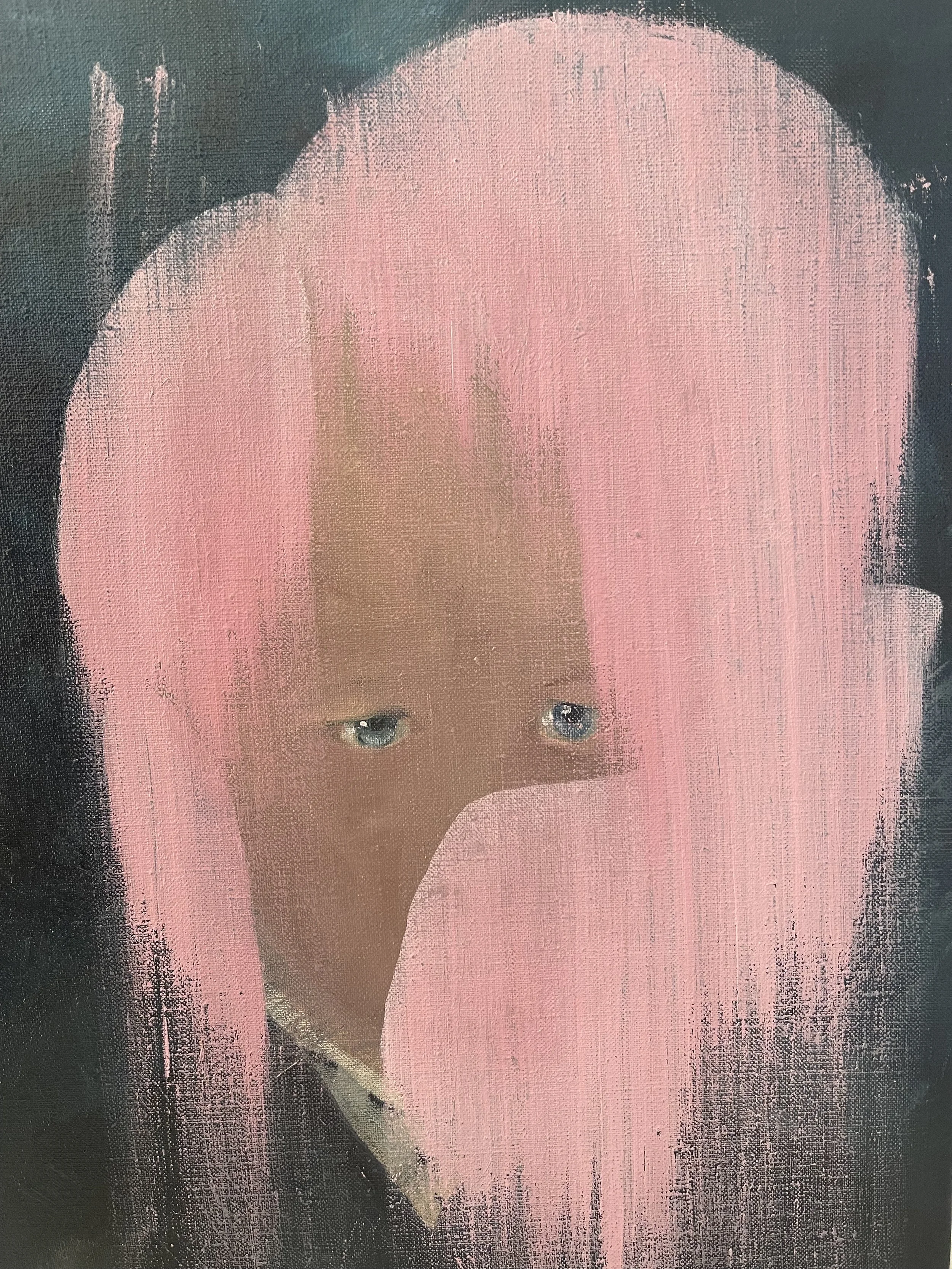
In this small, unsettling oil painting, the composer’s face barely holds. It emerges in fragments — a cheekbone here, the ghost of an eye there — only to be swallowed again by a veil of raw, misty pink that drips like spray paint across the surface. It’s not vandalism, but something quieter and more deliberate: a soft erasure, a rethinking.
Tchaikovsky, the canonical figure, the haunted genius, becomes a symbol not of himself but of all the so-called masters — those whose images are etched into our collective culture like marble busts. Here, though, he’s fragile. He’s melting under the pressure of new aesthetics, new values, new ways of seeing.
What’s compelling is how the pink paint — often coded as decorative, feminine, even unserious — becomes the very force that challenges and reclaims the image. It’s not destroying Tchaikovsky so much as insisting on its own right to exist alongside him, to obscure, question, or overwrite what was once unquestionable.
In its modest scale, the work speaks volumes. It’s part elegy, part act of rebellion. It asks who gets to remain visible, and at what cost. In a time when the old structures of power — artistic, cultural, patriarchal — are being re-evaluated and reframed, this small painting feels like both a quiet protest and a necessary exhale.
In this small, unsettling oil painting, the composer’s face barely holds. It emerges in fragments — a cheekbone here, the ghost of an eye there — only to be swallowed again by a veil of raw, misty pink that drips like spray paint across the surface. It’s not vandalism, but something quieter and more deliberate: a soft erasure, a rethinking.
Tchaikovsky, the canonical figure, the haunted genius, becomes a symbol not of himself but of all the so-called masters — those whose images are etched into our collective culture like marble busts. Here, though, he’s fragile. He’s melting under the pressure of new aesthetics, new values, new ways of seeing.
What’s compelling is how the pink paint — often coded as decorative, feminine, even unserious — becomes the very force that challenges and reclaims the image. It’s not destroying Tchaikovsky so much as insisting on its own right to exist alongside him, to obscure, question, or overwrite what was once unquestionable.
In its modest scale, the work speaks volumes. It’s part elegy, part act of rebellion. It asks who gets to remain visible, and at what cost. In a time when the old structures of power — artistic, cultural, patriarchal — are being re-evaluated and reframed, this small painting feels like both a quiet protest and a necessary exhale.